The stochastic analysis and signal processing lab works on the development of numerical and computational tools for the analysis of physical and mathematical systems under uncertainties.
Stochastic engineering dynamics & structural reliability
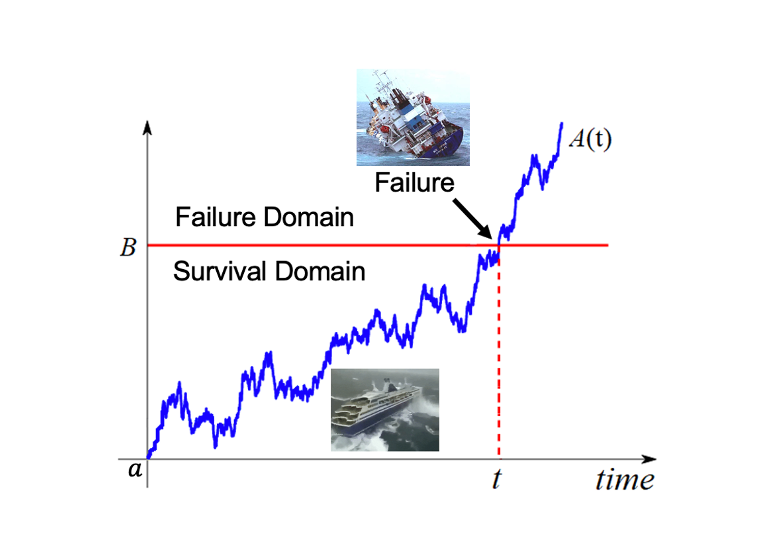
Several engineering systems are modeled as nonlinear oscillators such as high-rise buildings, vibratory energy harvesters, ships, etc. They are also typically subjected to random excitation modeled as either stationary (e.g., stationary wind excitation) or non-stationary (e.g., earthquakes) stochastic processes. However, estimating the probabilistic response of such complex systems could become intractable for high-dimensional systems whose failure modes have a low probability of occurrence. Therefore, there is a need for the development of more efficient methods capable of estimating the probabilistic response of nonlinear oscillators. This line of investigation focuses on the development of novel approximate/semi-analytical methods such as stochastic averaging, Wiener path integral, and statistical linearization for accelerating the stochastic response estimation of systems subject to random vibrations.
Selected publications:
P. D. Spanos, I. A. Kougioumtzoglou, K. R. M. dos Santos, A. T. Beck, "Stochastic averaging of nonlinear oscillators: A Hilbert transform perspective", ASCE Journal of Engineering Mechanics, 144(2):04017173, 2018.
K. R. M. dos Santos, I. A. Kougioumtzoglou, P. D. Spanos, "A Hilbert transform-based stochastic averaging technique for determining the survival probability of nonlinear oscillators.", ASCE Journal of Engineering Mechanics, 145 (10):04019079, 2019.
K. R. M. dos Santos, I. A. Kougioumtzoglou, A. T. Beck, "Incremental dynamic analysis: a nonlinear stochastic dynamics perspective", ASCE Journal of Engineering Mechanics, 142(10), 2016.
A. T. Beck, I. A. Kougioumtzoglou, K. R. M. dos Santos, "Optimal performance-based design of non-linear stochastic dynamical RC structures subject to stationary wind excitation", Engineering Structures, 78, 145-153, 2014.
Machine learning for generative and predictive modeling
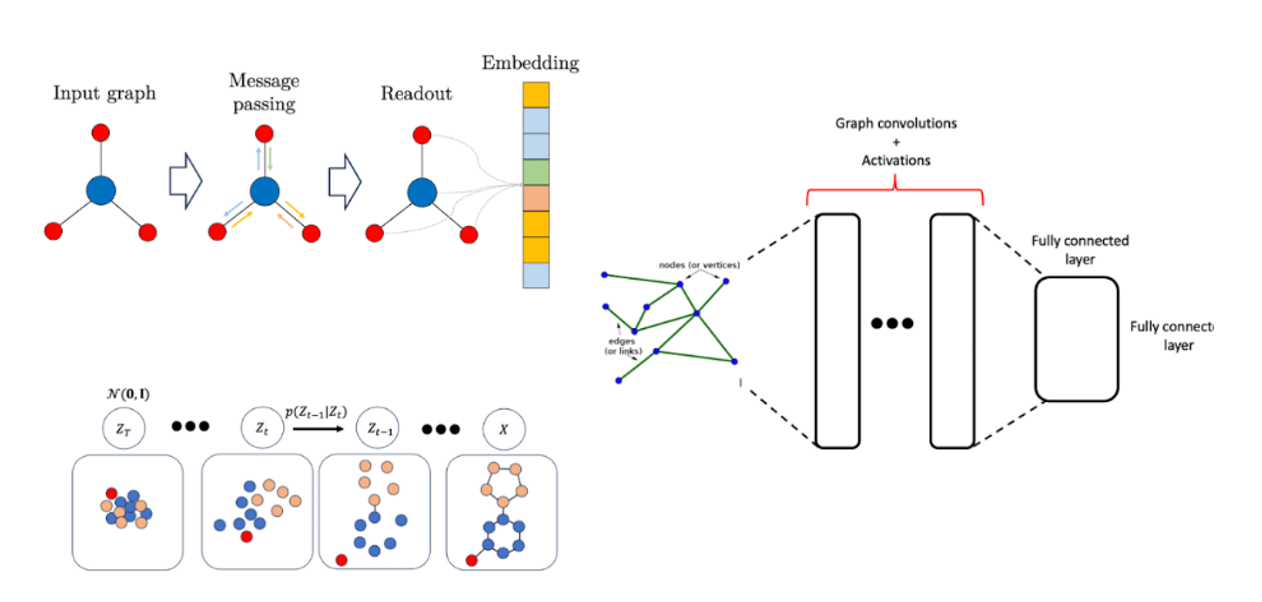
Machine learning (ML) has become necessary in scientific inquires due to the increasing complexity of data representation of mathematical and physical systems. The development of efficient, accurate, and reliable predictive and generative models constrained on the problem's physics is important for applications ranging from the analysis and design of chemical compounds to the monitoring of large civil infrastructure systems with digital twins. Considering the challenges faced by modern ML techniques, this line of investigation focuses on the advancement of the state-of-the-art of predictive and generative ML models on several fields of science and engineering.
Signal processing techniques for system identification and data reconstruction
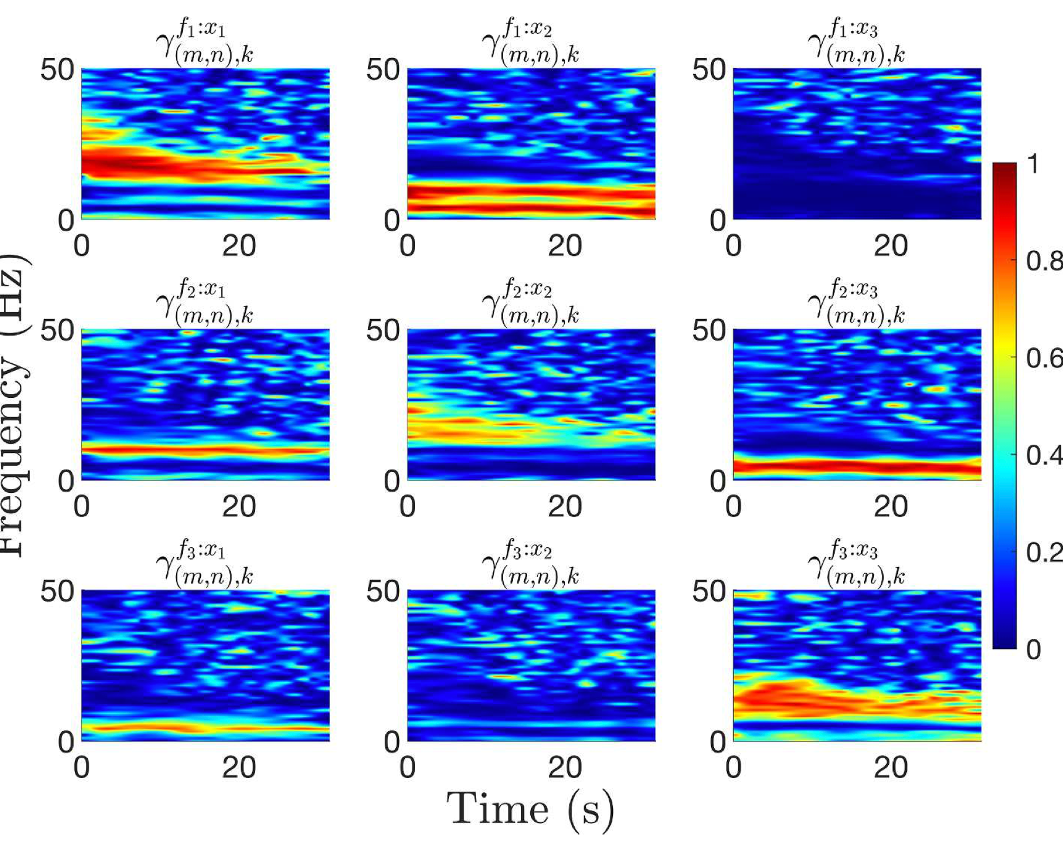
Signal processing techniques are powerful in the modeling and identification of systems subject to random vibrations as well as in the characterization of natural hazards. The analysis of both excitation and response of complex systems in the joint time-frequency domain has several benefits such as the evaluation of the time evolution of the frequency content of both response and/or excitation as a mean to detect anomalies in the structural response as well as to assess the non-stationary response of natural hazards such as earthquakes and wind gusts. Techniques such as wavelet analysis are typically employed in this task due to their proved performance of tracking the time-variant behavior of time-series. Moreover, in the real-world signals are typically subject to several sources of corruptions such as noise and missing data. Therefore, recovering such missing/corrupted information is necessary for tasks focused on the identification and characterization of complex systems. To this en, one can employ compressed sampling and sparse representation tools in the recovery/reconstruction of the missing information in both time series and matrices. Therefore, this research focused on the development of efficient, robust, and reliable tools used in the spectral characterization and in the system parameter identification of complex systems. Moreover, the development of advanced data-driven tools for the detection of anomalies in structural systems is also of interest.
Selected publications:
I. A. Kougioumtzoglou, K. R. M. dos Santos, L. Comerford, "Incomplete data based parameter identification of nonlinear and time-variant oscillators with fractional derivative elements", Mechanical Systems and Signal Processing, 94, 279-296, 2017.
K. R. M. dos Santos, O. Brudastova, I. A. Kougioumtzoglou, "Spectral identification of time-variant and nonlinear multi-degree-of-freedom structural systems subject to incomplete data.", \textit{Structural Safety}, 86, 101975, 2020.
G. D. Pasparakis, K. R. M. dos Santos, I. A. Kougioumtzoglou, Michael Beer, "Wind data extrapolation and stochastic field statistics estimation via compressive sampling and low rank matrix recovery methods.", Mechanical Systems and Signal Processing, 162, 1 January 2022, 107975.
B. G. Pantoja-Rosero, K. R. M. dos Santos, R. Achanta, A. Rezaie, K. Beyer. "Determining crack kinematics from imaged crack patterns", Construction and Building Materials, 343, 28054, 2022, https://doi.org/10.1016/j.conbuildmat.2022.128054